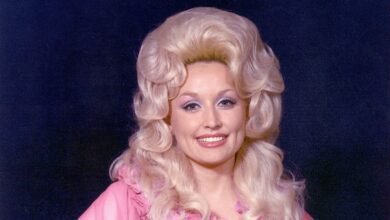

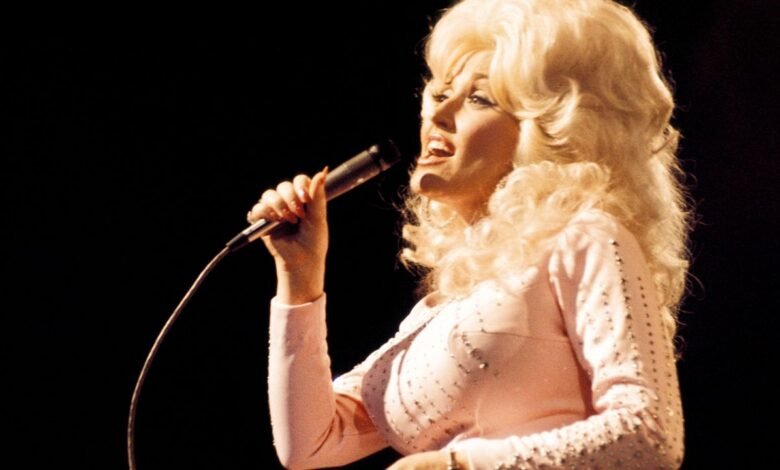
The singer-songwriter, author, actor, and philanthropist Dolly Parton has died at age 80, according to a statement from her family. To celebrate her exuberant life and work, we’re revisiting a 1994 profile of Parton—described as an “improbable American icon”—by Charles Gandee.
“Good Golly Miss Dolly” by Charles Gandee was published in the January 1994 issue of Vogue.
For more of the best from Vogue’s archive, sign up for our Nostalgia newsletter here.
Be out ’n a minute, hollers Dolly Parton
“Be out ’n a minute,” hollers Dolly Parton in that hallmark honey-coated hillbilly twang of hers—that car-ries, each dulcet trill intact, from the bedroom, where Parton is putting the finishing touches on her remarkable self, to the living room, where despite the balmy 72-degree L.A. day, a faux-log fire is blazing. And sure enough, a minute later, out comes the big-wigged diva carrying a Big Gulp-size plastic cup filled with Coca-Cola and wearing a black body stocking featuring a neckline that plunges all the way down to the very precipice of propriety. As Parton makes her way from the bedroom to the dining room to the living room, her size 5½ stiletto-heeled mules provide acoustic accompaniment—emitting roughly the same staccato snap as a flamenco dancer’s castanets.
With a wide feast-your-eyes grin, Parton extends the conspicuously manicured hand that’s not holding the Coca-Cola: “Howdyado?” She then kicks off her tiny mules and curls up on her sofa, which is uphol-stered, like virtually everything else in her Beverly Hills bungalow, in a pink-and-green Teflon-coated floral fabric punctuated with pink-and-green macaws. “I ain’t much of a hostess, so you just go on ahead and help yourself,” she offers, pointing one of her long coral acrylic fingernails toward the coffee table, where Mark, her brawny cowboy-booted bodyguard, has placed a shiny chrome thermos against the remote control that operates the fire. Spotting the tape recorder resting alongside the thermos, Parton adds with a smile: “You can turn that thing on whenever you’d like.” In other words, let’s get this show on the road.
Personal appearance seems an obvious point of departure.
“It’s a good thing I was born a woman or I’d a been a drag queen,” says Parton, exhibiting her famous talent for peppering her speech with selections from her well-rehearsed repertoire of guaranteed-to-get-a-girl-quoted quips. While there are those who might argue that being born a woman didn’t stop Parton from assembling herself with much the same caricatural zeal as cross-gender illusionists—the currently preferred term for drag queens—she does have one substantive advantage over her wannabe brothers. “I’m 40-20-36,” she confesses. “I used to never tell anybody my measurements, but the older I get the more proud I am.” Although each dimension is notable—particularly since Parton is a petite five feet one—it is the 20-inch waist that pleases her, though perhaps not her admirers, the most. And understandably so. Not since Hattie McDaniel cinched up Vivien Leigh in Gone With The Wind has a waist seemed quite so incredibly, so unbelievably minute. Parton attributes her exaggerated hourglass figure not to exercise—“I’ve never been that physical”—but to genetic good luck: “My daddy’s sisters always had tiny little waists and big boobs and big asses. My mama’s sisters always had small waists, and they had big asses but not necessarily that big a boobs. Well, they had nice boobs. But my daddy’s sisters had, you know, like these big huge boobs and little-bit-ty waists. I mean, they were famous for that.… Back home, everybody knew the Parton girls.”
Back home—in Sevier County, Tennessee—everybody knew this particular
Back home—in Sevier County, Tennessee—everybody knew this particular Parton girl as well, not only because little Dolly was what they used to call an early bloomer, but also because from the age of eight, she liked “to paint herself up just like a harlot,” very imaginatively employing kitchen flour for face powder, burned matches for eyeliner, wet crepe paper for eye shadow, Mercurochrome for lipstick, and crayons for rouge. And despite the fact that her grandfather was a hellfire-and-brimstone Pentecostal preacher, when little Dolly was nine, her fascination with feminine artifice even led her to sin. While on a class field trip to a supermarket, she shoplifted a tube of bright red lipstick. “I’m not a thief, but I smelled that lipstick, and I saw that lipstick, and I could not resist.”
The inspiration for Parton’s precocious preoccupation? “When I was little, I didn’t know what a whore meant or a tramp. But there were these three women in town, and I thought they were beautiful. Especially this one. She had this beautiful blond hair, red fingernails, high-heeled shoes, and hose with the seam up the back. And she’d walk the streets every Saturday. And then the guys would pick her up. And in my mind, as a little kid, that’s how I wanted to look. I have always said that honestly and truly I have patterned my look after the town tramp.”
Celebrating her forty-eighth birthday this month, Parton still adheres to the same basic love-for-sale look. In fact, with her platinum bouffant, fluttering false eyelashes, and flashy clothes custom designed by her personal dresser to showcase her gravity-defying and, consequently, much speculated-upon breasts, she is almost indistinguishable from the women who stroll Sunset Boulevard after sunset, a few blocks north of her house. Almost indistinguishable because, like Arnold Schwarzenegger and Sylvester Stallone with their rendition of pumped-up machismo, Parton carries her busty blond bimbo to the point of parody. The difference, of course, is that Parton makes it clear that she’s in on the joke—by grinning, giggling, and guffawing, by slapping her Lycra-encased thighs over her own risqué repartee. A few years back, at a birthday party for a close gay friend, for example, Parton presented the birthday cake to the blushing birthday boy with the arch directive, “Give it your best blow job.” More recently, one of k.d. lang’s gender-bending public antics inspired Parton to howl with delight, “That took some balls.”
More Mae West than Marilyn Monroe, more RuPaul
More Mae West than Marilyn Monroe, more RuPaul than Madonna, Parton’s bawdy, wink-and-a-smile style effectively defuses the very sex bomb her appearance initially sets off. She’s all show and no go, in other words. Or as the guys in junior high school used to say, “She’s advertising, but she’s not selling.”
Also disarming, of course, is Parton’s candor. A single example will suffice: Asked why her 1987 ABC variety show, Dolly, was canceled after one season, Parton replied without hesitation, “Because it sucked.”
The disparity between appearance and reality—between the bad girl Parton appears to be and the good ol’ girl Parton is—has rarely been so extreme. Or so freely acknowledged. “You don’t have to be a whore to wear a whore’s makeup,” she says. “Some people who are so refined and so conservative are the biggest tramps in the world. I’ve always said it was more important to be natural than to look natural.” After noting the somewhat obvious fact that “makeup has been like a big, big part of my life,” Parton obligingly retraces, step by step, the daily regimen required to create the look she loves: “I always start with foundation to even the splotches out and stuff. Then I use the powder next, then I work on my eyes—I wear false eyelashes, ’cause they just open your eyes more—then I put on the shadows, then I curl the eyelashes and put on the mascara, then I do the eyebrows, then I put on my cheeks, then I do my lip liner, then I fill in with whatever color I’m wearing that day, then I touch a little mascara on my natural beauty mark—otherwise it looks like a pimple—throw on a wig, put on some cheap, stretchy bodysuit … and here I am.” Although Parton prefers to have an hour to run through her routine, she claims that after all these years she’s got it down to 30 minutes—pat-shower to showtime.
The commercial potential of such expertise did not
The commercial potential of such expertise did not escape Parton, who is as savvy as she is sassy, and who approached Revlon chairman Ron Perelman with what proved to be an irresistible proposition. “Who better than me should have a line of makeup?” asks Parton rhetorically. “That’s all I do, play in makeup and, you know, hair. Everybody knows me for that.” Lest anyone get the wrong idea about her relationship with Revlon, however, Parton is quick to add, “It’s not me endorsing Revlon, and it’s really not Revlon endorsing me. We’re in cahoots. It’s a whole new thing.” Certainly Dolly Parton’s Beauty Confidence, as the one-stop-shopping system of “goof-proof” cosmetics is called, is a whole new thing for Revlon. Particularly since it employs the format so successfully employed by QVC and the Home Shopping Network, not to mention by Cher and Victoria Principal.
Debuting this month, Dolly Parton’s Beauty Confidence infomercial makes the most of its star, who gets things off to a rousing start by strumming her guitar and singing the infomercial theme song, “Confidence.” First verse: “Some are born with a silver spoon, under a lucky star. Most folks ain’t, but who says you can’t make the most of who you are. ’Cause it ain’t what you wear, it ain’t what you drive, everybody needs a sense of pride. It only comes from a place inside they call confidence.” Although the camera dutifully dotes on Parton—tracking her from her Greyhound-size bus to her “Tennessee mountain home” to her theme park, Dollywood, where a small army of relatives greet her with cheers—plenty of airtime is also given to flattering closeups of her “Light as a Feather” foundation and powder, her “Makin’ Eyes” eye shadow, her “A Kinder Liner” eye pencil, her “Get Glowing” cheek color, and her “Moisturific” lipstick. (Parton, as you may have deduced, named the products herself.) Throughout the 30-minute infomercial Parton effortlessly alternates between first plugging one thing and then another. “Wanna hear some music?” she shouts to a group of women that includes her sisters and her aunt Dorothy Jo, who shout back that they do. To which Parton retorts, “Of course you do, or I’ll fire you all.”
For those who succumb to the down-home pitch and, Visa cards at the ready, dial the toll-free number flashed on the screen, a spiral instruction book comes in the mail to explain the system. Adorned with ten photographs of Parton in ten poses, as well as a smattering of autobiographical anecdotes—“When people ask me why I wear five-inch heels, I tell them it’s ’cause I can’t find six-inch ones”—the book also includes a series of illuminating Dolly don’ts and Dolly do’s. A typical Dolly don’t: “Don’t let color stray down your cheeks—it looks drag-gy!” A typical Dolly do: “When wearing a low-cut blouse or dress, add a touch of blush to accentuate your cleavage and make the most of your assets. I’ve been making the most of mine for years!”
Considering her over-the-top image, not to mention
Considering her over-the-top image, not to mention her standing as camp icon, Parton very wisely, and very carefully, presents herself as inspiration rather than as model. “I don’t want people to try to look like me, I just want ’em to listen to me.” And although she does seem genuinely mystified by certain contemporary beauty trends—“Most people spend so much time looking natural, when somebody like me takes less time to look artificial”—she also seems willing to allow for the possibility of beauty in a somewhat lower key. “I just admire women who dare to be themselves,” says Parton, who attempts to display her catholic range by reporting that in addition to admiring Liz Taylor’s “glamorous” look, she also likes the “innocent, sweet” look of “the very soft Princess Di.”
After boasting that her lipstick isn’t drying, that her mascara isn’t gooey, and that her powder neither flakes nor cakes, Parton acknowledges that the most important feature of her product line is none of those things. But rather: “It has me to sell it. People believe in me. They know I don’t lie to ’em.” Energetically rallying to the commercial cause, Parton makes her pitch: “Look, I’m not saying that this is the best makeup that’s ever been. I’m telling you this is as good a makeup as there is on the market. It just has a lesser price tag and it is less complicated. And if you don’t like it, we’re thrilled to give your money back.” When asked to characterize her target customer, Parton answers: “I didn’t want to sell, like, to the fine department stores. There’s enough of that. I was more interested in selling to people like me and my friends and my family—Middle America. People that are simple people with basic money, but they still want good cosmetics.”
That Parton includes herself in “Middle America,” as one of those “simple people with basic money,” is something of a stretch for a woman who very righteously reports that she’d never simply endorse a product “just for another million dollars,” who very blithely notes that “it’s not fun to, like, get on an airplane and have to travel commercial.” Unnerving though it may be, however, straddling the socioeconomic fence is something of a Parton signature. While she loves, for example, to reminisce about her hand-me-down childhood—“Most people have three rooms and a bath. We had four rooms and a path”—she also loves to point out that “my house in Nashville is like Tara, like the old southern plantation with the big columns.… I’ve got 22 rooms, counting bathrooms, of course.” And while Parton may say “I count my blessings more than I count my money,” in the next breath she notes that despite the failure of the Dolly show, “we made our deal up front, and we got our money”—which she counts in the “millions.” In a similar vein, Parton claims that she “was more excited about Whitney Houston recording my song [‘I Will Always Love You’] because I wrote it than I was by the fact that it sold millions and millions and millions.” Sure enough, however, she follows up the line with “I made millions of dollars off of her recording of that.”
No doubt contributing to the plain/fancy switch-hitting
No doubt contributing to the plain/fancy switch-hitting is Parton’s exposure to the high-profile friends who surround her longtime business manager, Sandy Gallin, who is also her partner in the production company Sandollar. Gallin enjoys speeding down the Malibu-East Hampton fast lane, and Parton is frequently at his side on the journey. Although she hastens to point out that there’s a big difference between friends and acquaintances, Parton clearly enjoys her time in the company of, among others, Calvin and Kelly Klein, Barry Diller and Diane von Furstenberg, David Geffen, and Fran Lebowitz. Of the last, Parton adds, “I just love to talk to her. We have our own special kind of little friendship.”
Another special kind of friendship Parton appears to have is with her husband, Carl Dean, whom she met the day she arrived in Nashville in 1964 at a Laundromat called the Wishy Washy. “I was wearing hip-huggers and a little red rib tickler with ruffles,” she recalls. “I looked like the perfect whore.” The wedding was in 1966. Quips Parton, “I always say we met at the Wishy Washy and it’s been wishy-washy ever since.”
Although the marriage, as Parton will be the first to admit, is not a conventional one—in part because Dean, who retired from the asphalt paving business ten years ago, hates the limelight as much as his wife loves it—Parton says, “It’s worked real well … we’re good friends, friends … it’s just the way I like it.” Putting a somewhat finer point on the relationship, she adds, “We don’t get in each other’s stuff. It’s like I don’t step in his and he don’t step in mine. And when we do, we know we don’t want that on our shoes.” Not surprisingly, such provocative comments have prompted considerable speculation, which Parton takes in characteristically saucy stride: “I’ve been accused of a lot of relationships that I’ve never had. Of course, I have not been accused of some I have had.”
Considering Parton’s upbringing in the rural Tennessee Bible
Considering Parton’s upbringing in the rural Tennessee Bible Belt and her years in the stand-by-your-man country music industry, such an open-minded attitude about marriage, among countless other things, comes as something of a surprise. Particularly when Parton applies her live-and-let-live approach to, say, her immediate neighbors in Beverly Hills/West Hollywood: “Mostly it’s all gay up and down this street, and, you know, they’re just gentle, sweet, sensitive people. They never bother me. They want to protect me. They’re honored that I am here, and I am honored that they’re here. It’s a sweet feelin’.”
Such a permissive perspective is not the standard, as Parton will be the first to admit, among the ol’ gang at the Grand Ole Opry. “A lot of the real dyed-in-the-wool redneck people are very conservative and very religious,” says Parton, referring to the country music industry’s icy response to k.d. lang since lang made it known, to those who had somehow succeeded in not figuring it out, that she was a lesbian. Noting that lang is “a great writer, a great singer, a spectacular artist,” Parton adds, “She’s so out there that I think she frightened those people.” So why doesn’t lang frighten Parton? Isn’t the woman who recorded the gospel favorite Golden Streets of Glory religious? “I’m not so much religious as I am very spiritual,” Parton explains. “I’m just a very open person. I’m not judgmental of anybody. Maybe that’s just because I have always been different and always strived for acceptance and understanding, just being who I am and how I am.”
Parton’s relationship with the folks in Nashville hasn’t always been rosy itself. Although she has wisely kept at least one foot firmly planted in country music by continually touring and adding to the 62-and-still-counting albums she has completed to date, in 1974 Parton decided to “cross over” to other styles of music, to other forms of entertainment: “There was a lot of controversy that I was making a big mistake, that I was a traitor, and that I was gonna lose my country following.” So what prompted Parton to make the move, to leave her weekly spot on the Porter Wagoner Show (which landed her in a prolonged lawsuit), to become, as she sees herself, “the Henry Kissinger of country music”? “I wasn’t one of the number one country stars at the time, and I wasn’t makin’ any money, and I wasn’t gettin’ any younger either.”
In 1980 Parton made her move to Hollywood,
In 1980 Parton made her move to Hollywood, where she held her own alongside Jane Fonda and Lily Tomlin in the hit comedy 9 to 5. “That was a joy,” recalls Parton. “I thought, Lordy, mercy, what took me so long to get in the movies?” With the exception of Steel Magnolias, subsequent films, particularly The Best Little Whorehouse in Texas and Rhinestone, fell appreciably short of the mark set by Parton’s debut. “But that’s all right,” she says. “They were a hit with me.” Especially Rhinestone. “Although that movie was a flop, it was big with me because it was so healing. It was the first movie I did after my sickness, and it lifted me up, started my creative juices flowing again.” The sickness to which Parton refers occurred in the early eighties when she gained 50 pounds, disbanded her band, and retreated to her home in Nashville. “I went through some health problems, and I had some female surgery, and I was taking different kinds of medication. And on top of being overweight and all kinds of things, I was real depressed, too. It was a bad time in my life … a very dark period.”
About her future on the big screen, Parton is cautious: “There’s not many good scripts out there and certainly not many for me, ’cause I’m not that fine of an actress. Plus I’m not willing to come down so far, not willing to give up the big hair, the fingernails, or the high heels.” More likely, according to Parton, is another try at the small screen. “I had this idea to do a series called High and Mighty about a country singer that has a near-death experience, then becomes like a gospel singer. But everybody’s afraid to touch anything that’s religious because most of the people out here are Jewish, and it’s a frightening thing for them to promote Christianity. But that’s all right, ’cause now I’m gonna do that High and Mighty show as a TV movie of the week.”
For those still hankering for more Parton, a follow-up to the triple-platinum Trio album she recorded with Linda Ronstadt and Emmylou Harris in 1987 is now in the works. And Honky Tonk Angels, recorded with Loretta Lynn and Tammy Wynette, was released November 2—shipping 250,000 copies its first week. Her autobiographical My Life and Other Unfinished Business is due out later this year from Harper-Collins. “It’s the story of my life, my attitude, and my philosophy,” says Parton, who offers up a sampling of her no-nonsense attitude and down-home philosophy: “A lot of people say, ‘I’m fat because my mother slapped me when I was five.’ I say, ‘You’re fat ’cause you’re a damn hog.’” As for any major revelations, however, Parton reports that in My Life she does not kiss and tell: “I’m not going to admit nothing til I get caught at it. And then I’ll just defend myself the best I can.”
Not surprisingly, Parton also has ambitious plans to expand her Beauty Confidence cosmetics line, as well as branch out into wigs, hair products, perfume, clothes, jewelry, and countless other things, including a possible exercise video—“for lazy people like me.” And looking into the future, how does Parton see herself in, say, ten years? “Same thing,” she says. “Only probably more of it. A little thicker on the make-up. I hope I don’t get fat again, but I might. Maybe fat’ll be fashionable, and I can have a big ol’ time.”
Source: www.vogue.com